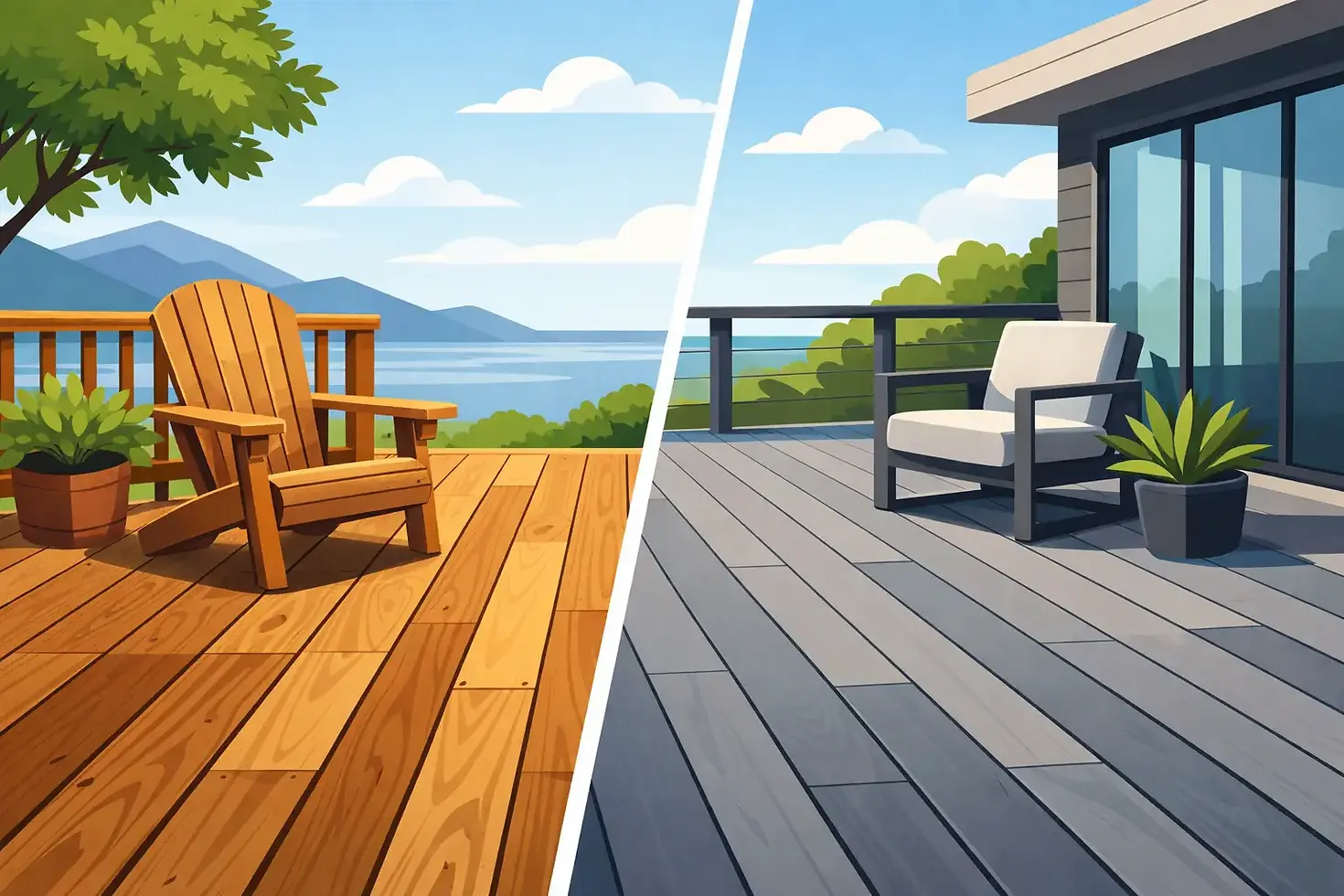
Wood Deck vs Composite: Which Fits Best?
- dannywnoel
- 2 hours ago
- 6 min read
A deck usually looks simple from the yard. In practice, the choice between a wood deck vs composite affects budget, maintenance, comfort, and how the finished space ages over time. If you are planning a new build or replacing an older deck, the right material depends less on trends and more on how you want to use the space year after year.
Some homeowners come in convinced that composite is the modern answer to everything. Others want real wood and do not see the point of paying more for boards made to imitate it. Both views miss the bigger point. A good deck is not just about the surface material. It is about structure, drainage, fastening, layout, stairs, railings, and how the whole build performs through weather, foot traffic, and seasonal movement.
Wood deck vs composite at a glance
Wood gives you a natural look that is hard to fake well. It can be milled, shaped, stained, and refinished, which makes it attractive for custom work and for homeowners who care about authentic material. Up front, wood is usually less expensive than composite, especially if you are comparing standard pressure-treated lumber to higher-end composite boards.
Composite is typically chosen for lower maintenance and longer-term consistency. It does not need staining, and it is less likely to split, crack, or develop the same weathered surface issues that wood does over time. That said, composite is not maintenance-free, and the upfront material cost is noticeably higher.
If you want the short version, wood usually wins on natural appearance and lower initial cost. Composite usually wins on reduced upkeep and predictable long-term performance. The better choice comes down to priorities, not marketing claims.
Cost is not just the price of the boards
When homeowners compare wood deck vs composite, the first number they ask about is material cost. That matters, but it is only part of the decision. Deck budgets are shaped by framing, footings, stairs, railings, skirting, site access, and finish details. The surface boards are important, but they are not the whole project.
Wood often lowers the initial build cost. Pressure-treated lumber is the usual budget-friendly option, while cedar and other premium species push the number upward. Composite boards cost more from the start, and depending on the brand and profile, the difference can be significant.
Over time, though, wood carries recurring costs. Staining, sealing, washing, sanding problem areas, and occasional board replacement all add up. If you hire that work out instead of doing it yourself, the gap between wood and composite narrows faster. If you enjoy maintaining wood and plan to stay on top of it, the long-term value equation changes.
This is where honest planning matters. A lower upfront number is only better if it still fits how you want to care for the deck five years from now.
Appearance and finish quality
For many homeowners, this is the deciding factor.
Real wood has grain, warmth, variation, and a natural depth that composite still works hard to replicate. On custom homes, heritage properties, and backyard spaces where material character matters, wood often feels more at home. It can also be selected and detailed in a way that gives the build a more tailored finish.
Composite offers a more uniform appearance. Some product lines do a good job mimicking wood tones and grain patterns, while others look more manufactured. The benefit is consistency. The drawback is that consistency can sometimes feel flat beside real lumber, especially on a smaller deck where every detail is easy to see.
Design matters here too. A well-built composite deck with clean picture framing, proper spacing, and refined railing details can look excellent. A poorly planned wood deck can look rough just as quickly. Material choice helps, but craftsmanship is what turns a deck into a finished outdoor space rather than a platform attached to a house.
Maintenance and long-term ownership
This is where composite usually makes its strongest case.
Wood needs care. Even pressure-treated lumber benefits from regular attention if you want it to keep looking good and last well. Sun exposure, rain, snow, leaf staining, and general wear all affect the surface. Without maintenance, wood tends to fade, dry out, splinter, and show checking over time.
Composite avoids much of that routine work. You are generally looking at cleaning rather than refinishing. For busy households, cottages, rental properties, or homeowners who simply do not want deck maintenance on the calendar every year, that is a real advantage.
Still, composite is not immune to wear. Dirt builds up, mildew can form in shaded areas, and cheaper products can fade or stain more than expected. Scratches are also harder to repair cleanly than on wood. With wood, a board can often be sanded, stained, or replaced with relative ease. With composite, repairs are more product-specific and not always invisible.
Performance in weather
In Ontario and across the Northeast, decks work through freeze-thaw cycles, wet springs, hot summers, and plenty of temperature swings. Material choice should reflect that.
Wood expands and contracts with moisture. It can cup, crack, and move, especially if lower-grade lumber is used or the deck is built without attention to drainage and ventilation. Done properly, wood decks hold up well, but they rely heavily on good construction practices and ongoing care.
Composite is more dimensionally stable at the surface, but it also reacts to heat and can expand and contract in length. That means installer guidelines matter. Board spacing, fastening systems, and end gaps are not details to improvise. Composite can also get hotter underfoot in direct sun than many wood options, which matters on exposed back decks and poolside layouts.
Weather resistance is not just about the decking boards, either. The framing below matters just as much. A deck with premium composite on weak or poorly protected framing is not a premium build. The structure has to last with the surface.
Comfort, use, and daily life
Think about how the deck will actually be used.
If you have kids running barefoot, direct summer sun can make composite less comfortable depending on color and product line. If you move furniture around often, surface scratching may matter more to you. If you grill, host, and eat outdoors every weekend, easy cleanup may push you toward composite.
Wood tends to feel more natural underfoot and can stay cooler in some conditions. It also develops personality with age, for better or worse. Some homeowners like that lived-in look. Others want a deck that looks nearly the same from one season to the next.
Daily life should shape the material. A deck is not a showroom sample. It is a working part of the home.
When wood is the better choice
Wood makes sense when the natural appearance matters most, when the budget is tighter at the front end, or when you want a material that can be customized and refinished over time. It is also a strong fit for homeowners who do not mind regular maintenance and appreciate the character that comes with real lumber.
For certain custom builds, wood can be the better design material. It can be trimmed, detailed, and integrated into stairs, skirting, and surrounding carpentry in a way that feels cohesive. That matters when visible finish quality is part of the goal.
When composite is the better choice
Composite makes sense when you want lower maintenance, longer-term visual consistency, and fewer surface issues as the years pass. It is often the better fit for busy households, second homes, and owners who would rather pay more once than keep revisiting upkeep.
It also suits homeowners who are replacing an older wood deck and have no interest in returning to sanding and staining. If the main goal is to enjoy the space with less ongoing work, composite is easy to justify.
The right answer depends on the build
The wood deck vs composite decision is important, but the build quality matters more than many homeowners realize. Proper footings, sound framing, accurate layout, stair geometry, drainage, and finish details will decide how the deck performs and how polished it looks.
That is especially true on custom projects where the deck ties into doors, grade changes, railings, rooflines, and the rest of the home. A well-designed deck should feel like it belongs there, not like it was added as an afterthought. That is where experienced carpentry pays off, whether the finished surface is wood or composite.
At Heritage Green Carpentry, that is usually the conversation first - not which material is trendier, but which one fits the home, the budget, and the level of upkeep the owner actually wants to live with.
If you are choosing between wood and composite, start with how you want the deck to look, how much maintenance you are willing to do, and how long you plan to stay in the home. The best material is the one that still feels right after the first season wears off.


Comments